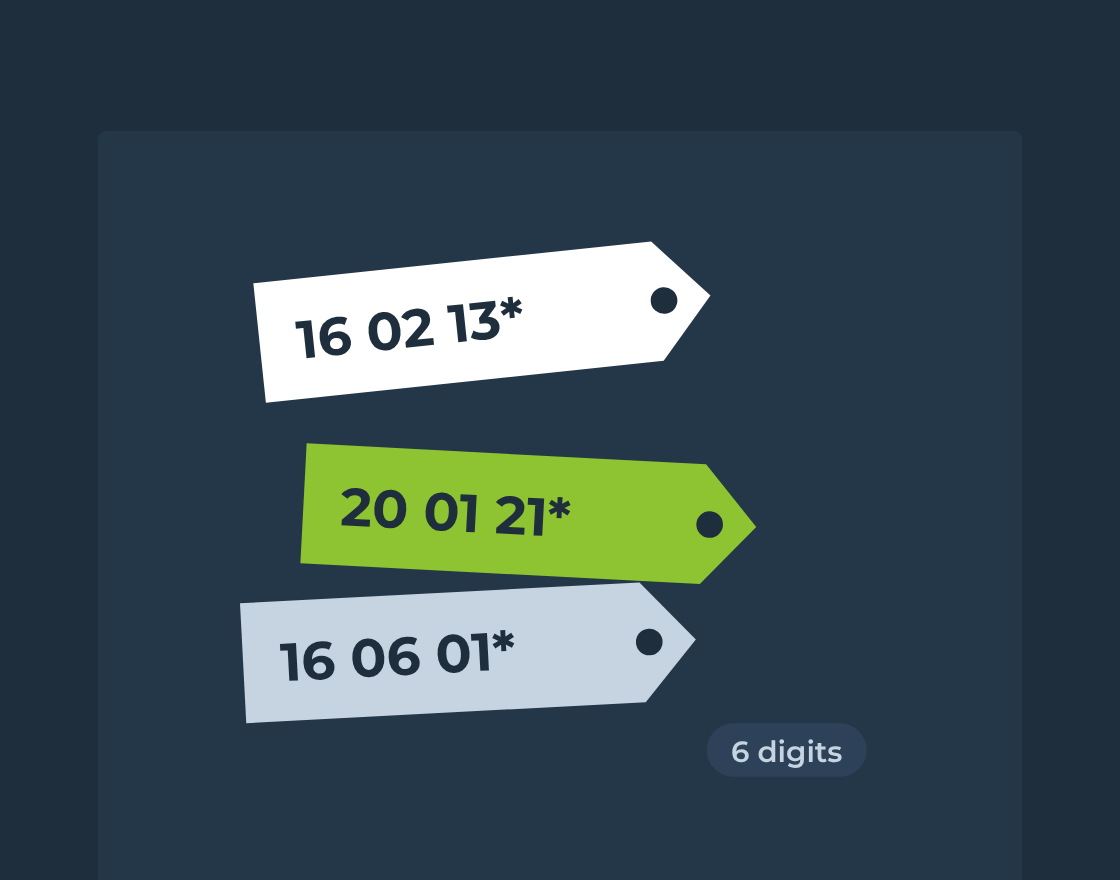
- EWC or List of Waste codes are six-digit codes built from a chapter, sub-chapter and entry; an asterisk means hazardous.
- Mirror entries need evidence from a safety data sheet or analysis, following the WM3 classification steps.
- Codes must appear on every waste transfer note and consignment note, and receiving sites now record them in Digital Waste Tracking.
EWC codes are the six-digit codes from the List of Waste that describe what a waste is and where it came from. Every waste a business sends for recycling or disposal must have one, and the code must appear on the waste transfer note or hazardous waste consignment note. Codes marked with an asterisk (*) are hazardous, and the WM3 waste classification guidance explains how to choose between them.
This guide covers how the list of waste codes is structured, how absolute and mirror entries work, the WM3 classification steps, and a quick reference for the electrical, battery and lamp codes we use most.
What EWC and List of Waste codes are
EWC stands for European Waste Catalogue. The UK now calls it the List of Waste (LoW). It was kept in UK law after EU exit and is published on legislation.gov.uk, and GOV.UK uses both names. The list gives every type of waste a six-digit code made up of three pairs:
- First pair, the chapter: the industry or activity that produced the waste, or a type of waste.
- Second pair, the sub-chapter: the process or sub-type within that chapter.
- Third pair, the entry: the specific waste.
So 16 06 01* breaks down as chapter 16 (wastes not otherwise specified in the list), sub-chapter 06 (batteries and accumulators) and entry 01 (lead batteries). The asterisk shows it is hazardous. The List of Waste states that any waste marked with an asterisk is hazardous waste.
The 20 chapters of the List of Waste
- 01 Mining, quarrying and mineral treatment
- 02 Agriculture, horticulture, aquaculture, forestry, hunting, fishing and food processing
- 03 Wood processing, panels, furniture, pulp, paper and cardboard
- 04 Leather, fur and textile industries
- 05 Petroleum refining, natural gas purification and pyrolytic treatment of coal
- 06 Inorganic chemical processes
- 07 Organic chemical processes
- 08 Coatings, adhesives, sealants and printing inks
- 09 Photographic industry
- 10 Thermal processes
- 11 Chemical surface treatment and coating of metals; non-ferrous hydrometallurgy
- 12 Shaping and surface treatment of metals and plastics
- 13 Oil wastes and liquid fuels (except edible oils)
- 14 Waste organic solvents, refrigerants and propellants
- 15 Packaging, absorbents, wiping cloths, filter materials and protective clothing
- 16 Wastes not otherwise specified in the list (including WEEE and batteries)
- 17 Construction and demolition wastes
- 18 Human or animal healthcare and related research
- 19 Waste management facilities and water treatment
- 20 Municipal wastes, including similar commercial, industrial and institutional wastes and separately collected fractions

How to find the right chapter
SEPA's guidance on using the EWC sets out the search order that most practitioners follow:
- Look first in chapters 01 to 12 and 17 to 20, which describe waste by its source. Ignore codes ending in 99.
- If nothing fits, look in chapters 13 to 15, which describe waste by type.
- If nothing fits there, look in chapter 16.
- Use a code ending in 99 ("wastes not otherwise specified") only as a last resort, with a detailed description.
Chapter 20 is not just for households. It covers municipal waste and similar commercial, industrial and institutional waste and separately collected fractions. Chapter 16 sub-chapter 02 covers discarded equipment from commercial and industrial sources. GOV.UK's WEEE table gives a household code and an industrial or commercial code for each item, so the source of the waste decides which one you use.
Absolute and mirror entries
WM3 sorts every entry into one of four types:
- Absolute hazardous (AH): always hazardous. If the waste fits the description, you must use that code. Example: 16 06 01* lead batteries.
- Absolute non-hazardous (AN): non-hazardous without further assessment. Example: 16 06 04 alkaline batteries.
- Mirror hazardous (MH): an asterisked entry that refers to hazardous substances or components. It applies only if the waste has a hazardous property (HP1 to HP15) or contains POPs above the limits. Example: 16 02 13* discarded equipment containing hazardous components.
- Mirror non-hazardous (MN): the paired entry, usually worded "other than those mentioned in". Example: 16 02 14.
For mirror pairs you need evidence for your choice: a safety data sheet, product information or laboratory analysis. GOV.UK says that if you are unsure whether an electrical item is hazardous or POPs waste, treat it as both as a precaution. Our guide to what makes waste hazardous lists the fifteen hazardous properties.
How to classify waste using WM3
WM3 sets out the waste classification process in seven steps:
- Check that the material is waste and needs classifying.
- Identify the List of Waste code or codes that may apply.
- Identify the type of assessment needed, based on whether the entries are absolute or mirror.
- Determine the chemical composition of the waste.
- Identify whether any substances are hazardous substances or persistent organic pollutants (POPs).
- Assess whether the waste has any hazardous properties.
- Assign the classification code and describe the hazardous properties.
GOV.UK adds some practical rules. The producer is responsible for classification. If one container holds more than one waste, each needs its own code. Landfill waste acceptance criteria (WAC) results must not be used to classify waste. And hazardous waste must not be mixed with non-hazardous or other hazardous waste.
Where waste codes appear
- Waste transfer notes: regulation 35 of the Waste (England and Wales) Regulations 2011 requires the written description to identify the waste by its List of Wastes code. See our waste transfer note guide.
- Hazardous waste consignment notes: Part B3 needs the six-digit code for each waste, with quantity, components, hazard codes and container details. See our consignment note guide.
- Digital Waste Tracking: since 1 October 2026, receiving sites in England and Wales record the List of Waste code for every load they receive.
- Permits: environmental permits list the codes a site may accept, so the code on your paperwork must match what the receiving site is authorised to take.
Quick reference: electrical, battery and lamp codes
These are the codes we see most on electrical waste, batteries and lamps. Descriptions follow the List of Waste wording. Always check the GOV.UK WEEE classification guidance for the item-by-item table.
Electrical equipment (WEEE)
- 20 01 35* discarded electrical and electronic equipment other than those mentioned in 20 01 21 and 20 01 23 containing hazardous components
- 20 01 36 discarded electrical and electronic equipment other than those mentioned in 20 01 21, 20 01 23 and 20 01 35
- 16 02 13* discarded equipment containing hazardous components
- 16 02 14 discarded equipment other than those mentioned in 16 02 09 to 16 02 13
- 16 02 11* discarded equipment containing chlorofluorocarbons, HCFC, HFC
- 20 01 23* discarded equipment containing chlorofluorocarbons
Fridges, freezers, chillers and air conditioning units with ozone depleting substances in the foam or coolant take 16 02 11* (commercial) or 20 01 23* (household). Displays containing POPs, such as CRTs and some flat screens, take 16 02 13* or 20 01 35*. See our electrical waste recycling service.
Lamps
- 20 01 21* fluorescent tubes and other mercury-containing waste
GOV.UK's WEEE table gives 16 02 13* for fluorescent tubes and other gas discharge lamps from industrial or commercial sources, and 16 02 14 or 20 01 36 for LEDs, halogen and incandescent lamps without POPs or hazardous substances.
Batteries
- 16 06 01* lead batteries
- 16 06 02* Ni-Cd batteries
- 16 06 04 alkaline batteries (except 16 06 03)
- 16 06 05 other batteries and accumulators (GOV.UK uses this for lithium and lithium-ion batteries)
- 20 01 33* batteries and accumulators included in 16 06 01, 16 06 02 or 16 06 03 and unsorted batteries and accumulators containing these batteries
- 20 01 34 batteries and accumulators other than those mentioned in 20 01 33
Mixed household-type batteries collected together take 20 01 33*. GOV.UK says batteries separated during waste treatment should not use 20 01 33* and should take the relevant 16 06 code for each battery type instead. Read how to dispose of batteries for storage and collection advice.
Common coding mistakes
- Using a non-hazardous mirror code without evidence that the waste does not meet the hazardous criteria.
- Putting a single code on a container that holds several wastes.
- Defaulting to a 99 code when a specific entry exists.
- Using a household code for commercial waste where GOV.UK gives a separate commercial code.
- Copying last year's codes when the waste or process has changed.
- Sending waste to a site whose permit does not list the code on the paperwork.
Frequently Asked Questions
What is an EWC code?
An EWC code is a six-digit code from the List of Waste that identifies a type of waste and the activity that produced it. Codes marked with an asterisk are hazardous.
What is the difference between EWC codes and List of Waste codes?
They are the same codes. EWC stands for European Waste Catalogue, the original name, and the List of Waste (LoW) is the name used in UK legislation and guidance today.
What is WM3 guidance?
WM3 is the waste classification technical guidance published by the Environment Agency, Natural Resources Wales and SEPA. It explains how to assess waste, decide whether it is hazardous and assign the correct List of Waste code.
What does an asterisk mean on a waste code?
An asterisk means the code is a hazardous waste entry. Absolute hazardous entries are always hazardous, while mirror hazardous entries apply only where the waste has a hazardous property or contains POPs above set limits.
What is the EWC code for fluorescent tubes?
Fluorescent tubes and other mercury-containing waste are 20 01 21*. GOV.UK guidance gives 16 02 13* for fluorescent tubes from industrial or commercial sources, so check which applies to your waste.
What is the EWC code for WEEE?
Commercial WEEE is usually 16 02 13* where it has hazardous components or 16 02 14 where it does not. Municipal-type WEEE uses 20 01 35* or 20 01 36, with 20 01 21* for lamps and 20 01 23* or 16 02 11* for equipment containing ozone depleting refrigerants.
How Waste Experts helps with waste codes
Waste Experts is an Environment Agency permitted Approved Authorised Treatment Facility (permit WEE/ME0006ZT/ATF) and Approved Battery Treatment Operator. We check the codes for every collection of electrical waste, batteries, lamps and hazardous waste, and they appear on the transfer note or consignment note we provide.
If you have mixed streams, we can advise on segregation so each container carries the right code. Explore our hazardous waste service and electrical waste recycling.
Business customers only. Waste Experts collects from businesses and organisations, not households, and CEF branch drop-off is for business waste only. If you are getting rid of waste from your home, use your council's household waste recycling centre or a retailer take-back scheme instead.
EWC codes are a short piece of text on your paperwork, but they decide how waste is handled, where it can go and which rules apply. Find the source chapter first, check whether the entry is absolute or mirror, gather evidence for mirror entries and code every waste separately.
For help classifying electrical, battery, lamp or hazardous waste, contact our team or request a quote.
Not sure which code applies?
We check the waste codes on every business electrical, battery, lamp and hazardous collection.
Talk to us