.svg)




- Digital Waste Tracking became mandatory for permitted waste receiving sites in England and Wales on 1 October 2026.
- In this first phase the receiving site does the reporting, so nothing changes for customers and existing paperwork still applies.
- Scotland and Northern Ireland receiving sites join in January 2027, and carriers, brokers and dealers in October 2027.
Digital Waste Tracking became mandatory for permitted waste receiving sites in England and Wales on 1 October 2026. We helped Defra shape the service before launch, so we would have looked daft if our own launch had gone badly. It didn't.
A launch day with nothing to report
The best thing we can say about 1 October is that it was uneventful. Everything we have reported through Defra's Report receipt of waste service has gone through without an error, and nobody on site has been unable to process a load.
The credit goes to Jane Richardson, our Head of Environmental Services, and her team. They did the unglamorous part: the set-up, the testing and the training for colleagues who needed it. By the time reporting became a legal requirement, it was already routine.
“Launch day felt like any other day on site, which is exactly what we were aiming for. My team did excellent work on the set-up well before 1 October, so when reporting became mandatory, everything went through first time. No errors, no queries, nobody unable to process a load. We delivered extra training where it was needed, and it showed.”
Jane Richardson, Head of Environmental Services, Waste Experts
We helped shape the system we now report to
Our part in Digital Waste Tracking started long before 1 October. Jane held three sessions with Daniel O'Driscoll, a User Researcher on Defra's Digital Waste Tracking programme, to help shape the service around the needs of waste businesses, producers and brokers. Credit to Defra for asking. A system designed without the people who use it tends to fail on contact with a weighbridge.
The first two were Teams calls, which are fine for talking through a process diagram and less useful for watching a curtain-sider reverse onto a tipping bay. So Daniel came to our Huddersfield AATF. He saw waste acceptance on site, how our drivers work through the driver app, and how that gives our customers information in real time. Jane called it testing the theory in reality.
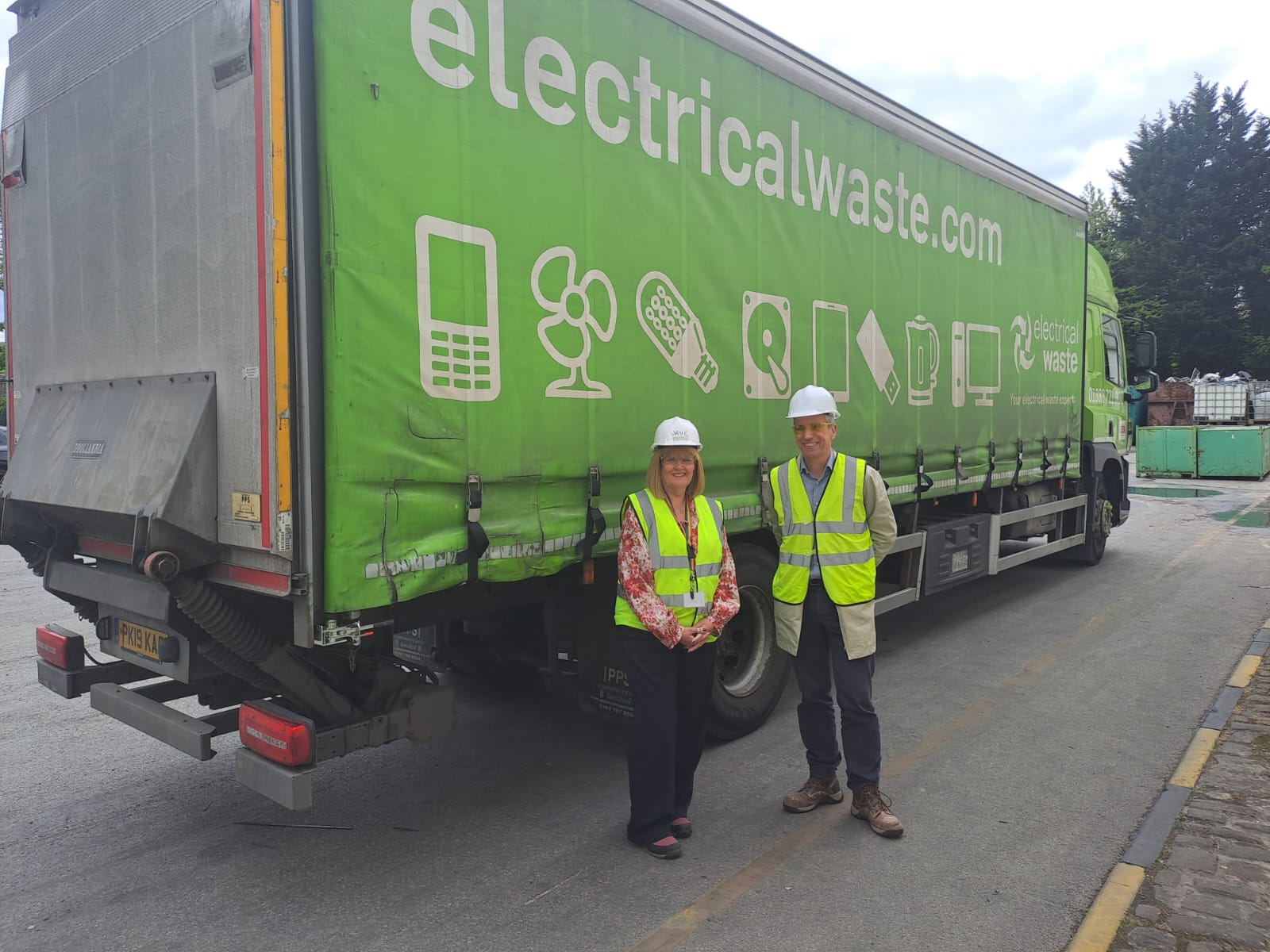
Jane Richardson with Daniel O'Driscoll from Defra's Digital Waste Tracking programme, on site in Huddersfield.
In the week before launch we joined Defra's testing panel and ran our own set-up in test mode, on Defra-approved software, with our treatment site registered. By the time reporting became mandatory, we had already run the process end to end.
What changed on 1 October
Every licensed or permitted site in England and Wales that receives controlled waste must now report each load to Defra. The deadline is two working days, counted from the day after the waste arrives.
Each record covers the movement itself, the carrier, the receiving site, the waste classification codes and how the waste will be recovered or disposed of. Hazardous waste and waste containing persistent organic pollutants (POPs) need more: hazard codes, components and concentrations. We handle WEEE, batteries and other complex waste streams, so that extra detail applies to a lot of what comes through our gates.
The point of all this is waste crime, which the Environment Agency estimates costs the UK economy £1 billion a year. Paper records left regulators with gaps. A digital record of every load received closes many of them.

What it means if we handle your waste
For now, very little changes on your side. In this first phase the duty to report sits with the receiving site, so we do the reporting.
- Your paperwork stays the same. Waste transfer notes and hazardous waste consignment notes are still required. They run alongside the digital record until further notice.
- Every load is logged. What we receive from you goes to Defra within two working days.
- We may ask for more detail. If we need extra information on a load to complete the record accurately, we will get in touch.
Your waste is going to a permitted site that has reported correctly from day one. If you want to know how your collections are being recorded, call us on 0800 804 8612.
Digital Waste Tracking covers waste once it leaves your site. If you also place electricals, batteries or packaging on the market, those are producer obligations under a separate regime. Our compliance scheme, WERCS, handles those end to end.
What comes next
This is phase one, and two more dates are already set:
- January 2027: receiving sites in Scotland and Northern Ireland are due to join.
- October 2027: carriers, brokers and dealers must use the service, with public testing from spring 2027.
Once collectors are in, the record will follow waste from the point of collection to the site that receives it. We collect as well as receive, so phase two applies to us too. We intend to make that launch just as uneventful.
Is your waste being reported properly?
Your Duty of Care record is only as good as the site receiving your waste. Tell us what you produce and we will tell you where you stand.
Speak to an expert