.svg)



Why IT Asset Disposal Is a Legal Issue, Not Just a Logistics One
When a business refreshes its IT equipment, the old devices do not simply stop being a liability. Laptops, desktops, servers, monitors, mobile phones and storage media are regulated under two separate pieces of UK legislation simultaneously: data protection law and waste management law. Getting IT asset disposal wrong can expose your business to enforcement action from two different regulators at once.
The first risk is data. Research consistently shows that a significant proportion of second-hand hard drives sold on the open market still contain recoverable data from previous owners. For UK businesses, this is not just embarrassing - it is a direct breach of the UK General Data Protection Regulation (UK GDPR) and the Data Protection Act 2018, both of which require organisations to implement appropriate technical measures to protect personal data until it is irretrievably destroyed. The Information Commissioner's Office (ICO) can issue fines of up to £17.5 million or 4% of global annual turnover (whichever is higher) for serious data protection breaches.
The second risk is environmental. IT equipment - laptops, monitors, servers, printers, phones - is classified as Waste Electrical and Electronic Equipment (WEEE) under the WEEE Regulations 2013. Businesses have a legal obligation under these regulations to ensure that WEEE is only handled by an Approved Authorised Treatment Facility (AATF). Simply skipping IT equipment into a general waste bin, or handing it to an uncertified operator, is a criminal offence enforced by the Environment Agency.
What Is IT Asset Disposal (ITAD)?
IT Asset Disposal - commonly referred to as ITAD - is the structured, legally compliant process of decommissioning, sanitising and disposing of end-of-life technology. A properly executed ITAD process covers:
- A full inventory and audit of all assets being decommissioned
- Certified data destruction for every data-bearing device
- WEEE-compliant recycling or refurbishment
- A documented chain of custody from collection to final processing
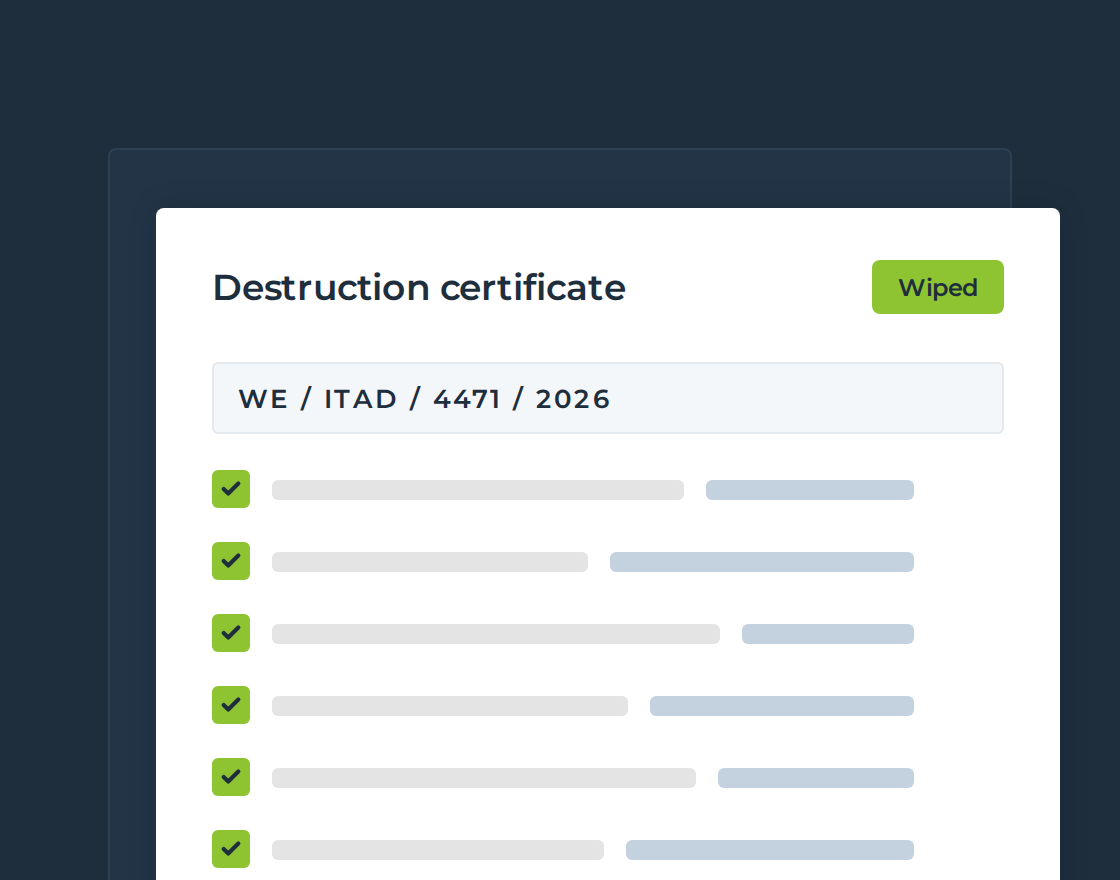
- Certificate of data destruction for every device processed
- WEEE compliance documentation and waste transfer notes
Each element matters. A certificate of data destruction is not just a piece of reassurance - it is the evidence you need to demonstrate compliance if the ICO or Environment Agency ever investigates.
Data Destruction: What Methods Are Legally Defensible?
Deleting files, formatting a drive, or performing a factory reset does not destroy the data on a device. These processes remove file pointers but leave the underlying data intact and recoverable with widely available software.
The UK GDPR and the Data Protection Act 2018 require that data is destroyed using methods appropriate to the sensitivity of the information and the risk of unauthorised access. In practice, for business IT assets, this means one of the following:
- Certified data erasure - software-based overwriting of every sector of a hard disk drive, verified and certified. Appropriate for HDDs. Not sufficient for SSDs or flash storage, where data remnants can survive overwriting.
- Degaussing - exposure to a powerful magnetic field that destroys data on magnetic media. Renders the drive inoperable but provides a high assurance of data destruction for HDDs and magnetic tapes.
- Physical shredding - mechanical destruction of the drive or device. The most absolute method and appropriate for SSDs, flash memory, mobile devices and any media containing highly sensitive data. A shredded drive cannot be recovered.
The appropriate method depends on the sensitivity of the data, the type of storage media and your organisation's risk appetite. Your ITAD provider should advise on this and provide individual serial-number-level certificates of destruction for each device - not a single batch certificate covering a consignment.

WEEE Compliance: The Environmental Side of IT Disposal
Separately from data protection, IT equipment disposal is governed by the WEEE Regulations 2013. These regulations place specific obligations on businesses disposing of electrical and electronic equipment. The categories of IT equipment covered include:
- Computers, laptops and tablets
- Monitors and display equipment
- Servers and networking equipment
- Printers and multifunction devices
- Mobile phones and smartphones
- Storage media and peripherals
Under the WEEE Regulations, business users must ensure that their WEEE is processed by an Approved Authorised Treatment Facility (AATF) - a facility licensed and recognised by the Environment Agency. Only AATFs can issue the WEEE Evidence Notes (WEEENs) that formally demonstrate compliant disposal.
Alongside this, your duty of care under Section 34 of the Environmental Protection Act 1990 requires that IT waste is transferred to a licensed waste carrier and accompanied by appropriate documentation. Read our waste duty of care guide for a full breakdown of the documentation requirements that apply to every business in the UK.
Handing IT equipment to an uncertified operator - even one offering a free collection service - leaves your business exposed to Environment Agency enforcement and potentially liable for any environmental harm caused by improper processing. Where IT equipment may contain hazardous materials, a Hazardous Waste Consignment Note is required rather than a standard Waste Transfer Note. Our hazardous waste regulations guide explains when this applies.
What Documentation Should a Compliant ITAD Provider Give You?
A credible, compliant ITAD partner will provide the following documentation as standard for every consignment:
- Certificate of Data Destruction - confirming the method used and listing individual serial numbers of all data-bearing devices processed
- Waste Transfer Note or Hazardous Waste Consignment Note - confirming the waste has been transferred to a licensed carrier and AATF
- WEEE Evidence Note - issued by the AATF, confirming the weight and category of WEEE processed
- Asset audit report - a reconciled inventory of every device collected versus every device processed
If a provider cannot give you all of these documents, they are not providing a compliant service. For many organisations, best practice is to retain ITAD documentation for six years, aligning with general records retention periods for audit defence.

Building a Defensible ITAD Policy
Organisations that handle IT asset disposal on an ad-hoc basis are exposed. Without a formal policy, devices can leave your premises untracked, creating both data security gaps and environmental compliance failures. An ITAD policy should define:
- Which asset types fall within scope (laptops, servers, phones, storage, peripherals)
- Who in the organisation is responsible for decommissioning decisions - typically IT, compliance and data protection officers
- The approved methods of data destruction for each device type
- The approved suppliers your organisation will use, and the minimum documentation standards required
- Retention periods for ITAD records
The policy should be reviewed at least annually and any time your IT refresh cycle changes significantly.
How Waste Experts Handles IT Asset Disposal
Waste Experts is an Approved Authorised Treatment Facility (AATF) regulated by the Environment Agency. We provide a complete IT asset disposal service that addresses both your data protection obligations and your IT equipment recycling and WEEE compliance requirements under one contract.
Our electrical waste recycling service covers all categories of WEEE including IT equipment. Our ITAD service includes secure collection by our licensed fleet, certified data destruction - shredding, degaussing or verified erasure according to device type - and WEEE-compliant recycling at our in-house AATF facility. We provide individual Certificates of Data Destruction at serial number level, the correct waste transfer documentation, WEEE Evidence Notes and a full asset audit report reconciling collected versus processed devices.
All documentation is accessible through our customer portal, giving you a complete, audit-ready compliance trail for both ICO and Environment Agency purposes. We handle collections of all scales - from a handful of retired laptops through to full data centre decommissioning.
If your business also has WEEE producer compliance obligations - for instance if you manufacture or import electrical equipment - WERCS provides specialist producer compliance scheme membership covering WEEE, battery and packaging regulations.
Contact Waste Experts today to arrange a compliant IT asset disposal collection.
IT asset disposal sits at the intersection of two regulatory regimes - data protection and environmental compliance - and failing on either front carries serious consequences. The obligations are clear: data must be irreversibly destroyed using a method appropriate to the device type and sensitivity, and the hardware must be processed by a licensed AATF with full documentation at every stage.
Businesses that treat ITAD as a box-ticking exercise - handing old equipment to whoever turns up and collects it for free - are taking on significant risk. An AATF-accredited partner with documented chain of custody removes that risk entirely. Get in touch with Waste Experts to discuss your IT disposal requirements.